Translate

Wednesday, April 3, 2013

Drivers' Dilemma


In previous postings I have discussed some of the difficulties that the USCR organizers were facing in the merger of the ALMS and Grand-Am into their new series. There are some difficulties that the teams and/or drivers will have to work out too. Among these difficulties for some teams is that of reconciling their driver line-ups when their drivers have been participating in both the old ALMS and Grand-Am series.

Looking at the entry lists for the ALMS Sebring 12-hour and the Grand-Am Daytona 24-hour races I found 19 drivers that have a conflict (not including LMP1 since they won't be in the USCR for 2014). Here is a table of those drivers, with their team affiliations and classes:


There are a number of ways this will be dealt with. Here are a few:

A.) The "Scott Tucker" approach: If the same team utilizes a driver in both series, they could split their stints between cars. This will only work on the longer races, since the minimum driving time would be hard to cover in the shorter races. Also, I don't think switching between a prototype and a GT within a single race is such a good idea. 

B.) Teams may consolidate: Two teams may join forces and share drivers. The factory teams probably wouldn't do this, but it might make sense for some of the smaller teams. They might still need additional drivers if the "A" approach doesn't work for them; or they may also incorporate the "D" approach (see below).

C.) Bring in additional drivers: Depending on the contracts involved and the relationships that have developed, a driver may just pick one team and vacate his seat in the other team. This leaves an opening for an additional driver. 

D.) Lower the car count: Multi-car teams may reduce their car count so their driver line-up will cover their program. Teams with a single car in each series may have to choose one car and sell the other.

I don't think anyone is expecting all cars from both series to be running in 2014. If they did all show up, the grid would be too large for some of the venues. I do think there will be some openings for additional drivers on some teams and I think that there will be some reduction in car-counts. There may also be some team consolidation. Further complicating the team driver line-ups is the Pro/Am formulae used in P2 and GTC; assuming those formulae are retained. The driver formulae issue was not addressed in the new class structure announced by USCR.

A lot is riding on the  2014 USCR season being successful. If it is there may be opportunities for increased sponsorship, allowing teams to grow, opening up seats for additional drivers. I am keeping my fingers crossed.


Saturday, March 23, 2013

What Sebring 2013 Told Me

The Tale of the Tires

One of the things I was curious about during this year's running of the Sebring 12hr. was what might be learned about the wholesale change in tire formulae in LMPC and GTC. 

Since the introductions of these two spec classes in the ALMS, they have used spec tires: Michelin for LMPC and Yokohama for GTC. This year, in a preview of changes coming in 2014, both classes are now running on Continental tires. All of the Grand-Am cars run on Continentals, but until now none of the ALMS cars had been using them. How do these tires measure up? Only the team race engineers will know definitively, but I could at least look at some data and see if I can get some indication of what the change means.

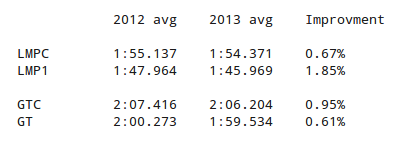
So, I looked at data from both the 2012 and 2013 Sebring qualifying results. I took the average qualifying lap times for the entire LMPC and GTC classes for comparison. There have been no major changes in those classes except for the tire change. To get an idea of what sort of year on year improvements (and/or track conditions) might mean, I also calculated the mean qualifying lap times for LMP1 and GT classes. I took the mean of all LMP1 competitors but only the ALMS GT teams (excluding the WEC teams from 2012 to reduce variation). Here are the results:

Average Qualifying Lap Times

I can't draw too many conclusions from these limited data. What I can see, at least for qualifying, is that the Continental tires are not a step backward. While the LMPC change shows a slight improvement, it is in line with year on year progress (or perhaps just better track conditions). The GTC class also show improvement, in fact it shows somewhat better improvement than might be expected year on year (with the usual caveats). The LMP1 class shows a marked improvement over last year, but being true prototypes, that should probably be expected. I didn't look at LMP2 times for two reasons: they too were forced into changing tires this year, not by the organizers but by Dunlop Racing pulling out of the series and they are spec Michelins rather than bespoke Dunlops, making comparisons problematic. All but one of the LMP2 runners are running  Michelins, where all but one were running Dunlops last year.

These results are for qualifying. It says nothing about wear characteristics and fall-off on longer runs. From anecdotes relayed by pit reporters, the LMPC teams seemed happy with their new tires.

Coverage of the Race

First you need to know that I can't get Speed/Fox from my local cable TV monopoly. This means that I was entirely reliant on on-line streaming for my live race coverage. Luckily the U.S. Virgin Islands are considered "International" by the ALMS web site, so I was able to watch the entire race live. I had it better than the stateside fans who were without Speed/Fox, they had no sanctioned streaming alternatives.

Last year the ALMS stream was profoundly broken for the first half of the season as I reported here. This year's Sebring round video was provided by Speed (last year's came from ESPN). Audio commentary for both years were provided by John Hindhaugh and Jeremy Shaw. I had only minor glitches in the stream, but others who attempted to connect after the race began, reported serious problems even getting the main ALMS site to respond. In fact there was a complete outage for everyone late in the race that was reported to be due to a "satellite outage". I seriously doubt that was the actual problem, but the stream eventually did recover. I believe that the web site was seriously under-provisioned; there were reports of over double last year's viewership. Anyway if last year's streaming coverage was an "F" this year's (so far) would earn a "C-"; when you could get on it was fine, but it was difficult to get on. In a 12-hour race I expect minor malfunctions, but under-provisioning is inexcusable.

The fact that there was no live stream available in the home market for the U.S. fans is also inexcusable. Last year you could at least subscribe to ESPN Player for a reasonable fee. Of the remaining ALMS rounds for 2013 only Petit Le Mans will be on Speed/Fox; the rest will be back on ESPN and therefor available on ESPN Player. International fans (like me) can get the ALMS feed. I have also subscribed to ESPN Player in case.

The Race

We had some good racing this year. As I write this, the video of the race has not yet been posted, but the qualifying can be seen here. Next week the full race should be posted. 

There were only four safety-car periods; the fewer of these the better. The race director was very strict and consistent in calling avoidable contact penalties, much to the consternation of those penalized. Perhaps there were some marginal calls, but I think calling them tight during the first race of the season might lessen damages throughout the remaining rounds. It seemed that a similar strategy was being followed during the Grand-Am Daytona 24 back in January; lots of penalties and fewer safety-car periods. I hope this heralds an adherence to these higher driving standards once the ALMS and Grand-Am teams are on the same track in the 2014 USCR series season.

UPDATE: 
Archived video of the 2013 12 Hours of Sebring can be found on the ALMSOfficialVideos channel of Youtube. For some reason they have not yet (31 Mar 2013) posted the race on their own web site.

Thursday, March 14, 2013

The United SportsCar Racing series


Finally the merged ALMS-GrandAm series has a name: United SportsCar Racing. It's not the most exciting or imaginative name perhaps, but it has accomplished a couple of important things: we now know what to call it, and probably of more importance, it is not divisive. If the new name had been a derivative of either of the old names, it would tend to alienate fans from the "other" old series. If the name had been to jingoistically "American", it might have turned-off some of the international fan base (but it still manages to get that "U.S." in there). While the new name doesn't excite me, I am relieved that undue partisanship was avoided. I hope this is an indication of the continued ecumenical tenor exhibited thus far by former ALMS and GrandAm principals.

Along with a new series name, the new competition class names were announced today as well. Again the names were unexciting but also uncontroversial:


No further information about the details of the classes were discussed. We still don't know driver regulations for the former LMP2 and LMPC classes. We know that the Prototype Challenge cars will be running spec Continental tires, but will there be any classes with an open tire formula? There were several questions about homologation (particularly with regard to DP/P2 performance balancing), but again no definitive answers were given.

The sole sanctioning body for the United Sportscar Racing series will be IMSA, which gets a new logo. IMSA will also get a "refresh", the details of which were not discussed.

At the announcement press conference, there was a question about series sponsors. Tequila Patron currently sponsors the ALMS and Rolex currently sponsors Grand-Am: who will be the new series sponsor? No definitive answer was given.

There are many things yet to be worked out within the new United Sportscar Racing series before 2014. My hope is that the USR principals mean what they say and continue to try to preserve the "best of the best" of endurance sports car racing in North America.

UPDATE:

The day after the press conference announcing the new series and class names, there was a licensing and partnership agreement between the new series and the ACO. This allows the retention of the name "Petit Le Mans" for the 10-hour Road Atlanta event, and formally retains a connection between the ACO and both the GTLM class and select LMP2-spec cars in the Prototype class.

There are two reasons this agreement that brightens my day a bit: it makes the stated intention to keep LMP2 cars close to the ACO spec (allowing them to be eligible for Le Mans) a bit more concrete, and there is some hope that in the future the USCRS Prototype class will evolve to be more compliant with the rest of the international sports car world. I think it is in the interests of both the ACO and USCRS to cooperate in formulating future regulations.

Friday, January 4, 2013

Politics vs. Performance


Today was the long-awaited preliminary announcement of the unified ALMS – Grand-Am class structure for 2014. I never expected a comprehensive announcement that would include regulations, but I was disappointed and saddened by what came out today. Besides reading the announcement, I followed the Q&A at the associated press conference live on radiolemans.com (RLM) and participated in RLM's on-line forum. In this post I will be discussing the prototypes primarily: LMP2, LMPC and DP. The announced class structure reflects a bias of political considerations over performance.

My first disappointment was that, as feared, the intent is to combine LMP2 and DP into a single class and balance their performance (BoP). This is just wrong. It reflects a political stance on the part of Grand-Am that, no matter what , “their” DP cars must be in the top class, no matter that they are far slower on all 4 tracks that both series competed on in 2012 (see table). Why? Based on both performance and differing regulations, these two cars are in fact in two separate classes and should have been treated that way. There would be plenty of opportunity to rectify both cars in 2015 when regulations could be re-written to unify them into a single class in subsequent years. BoP should only ever be used within one class, not to force two classes to compete as one. Properly designed regulations should eliminate BoP altogether in a perfect world.

Table 1. Fastest Race Laps 2012

The inclusion of LMPC as a “second” prototype class was unexpected. I am sure this was done to preserve car-count in the prototype classes and I have no problem with that as a short-term strategy. That class has produced great racing in the ALMS for the last 4 years. Given that LMPC is to be included, the DPs and the LMPCs are nearer in performance than DP and LMP2, so I have to wonder on what basis, other than politics, that DP and LMPC weren't combined if they needed to combine two cars into one class. Of course the LMPC is still faster than the DP, but at least they would only have to use BoP on one chassis/engine combination against the DPs which are already balanced against one another. By not doing this the new series has made their jobs harder, for merely political reasons.

I have difficulty seeing a reason other than politics for slowing down two other classes (LMP2, LMPC) to allow DPs to run in the "top" class. Perhaps the intent is to better guarantee Grand-Am teams and sponsors that a DP will win overall? Where would that leave ALMS LMP2 teams?

Since the merger was first announced there has been a concern that too many classes would somehow confuse the fans. I don't see it. I know that ALMS fans enjoy multi-class racing and have done so for 15 years. Many ALMS fans also follow Grand-Am, so what is the evidence that this is a problem? This concern is one excuse for combining LMP2 with DP and I don't buy it. Multi-class racing came about to give more variety to larger fields of competitors, combining classes is just wrong.

There was a question asked at the press conference about tires. They answer was vague but the message seemed to have been suggesting that Continental might be the sole tire supplier. If this is so, that would be a huge change for all the ALMS teams, none of whom run Continentals. Another question was asked about alternative fuels, a major feature in the ALMS. The answer suggested that Sunoco would likely continue as the sole fuel supplier, alternative fuels or not. Both of these answers made it obvious, if it weren't already, that this “merger” is really largely a takeover of ALMS by Grand-Am.

One issue not addressed by the press conference at all was driver qualifications. The current LMP2 class is a Pro-Am driver class, there must be at least one “Bronze” or “Silver” (amateur) driver for each car as determined by the ACO. The GTC cars may only have at most one “Gold” or “Platinum” (professional) driver for each car as determined by the ACO. No amount of BoP will get around those regulations, it will have to be addressed directly.

The announcement of the merger last September has made life for the competing teams in both the ALMS and Grand-Am much harder. They could make no concrete plans for 2014, and getting and keeping sponsorship for 2013 was problematic.  The bankruptcy of Lola had already had a negative impact on the LMP2 class, in the U.S. As well as in Europe. This situation has thrown doubt about participation in the ALMS LMP2 class for 2013. Come 2014, there may be no LMP2 cars to worry about. This too is, at least partially, a consequence of politics. It would have been better to have organized a sensible class structure and had draft regulations ready prior to announcing the “merger”.

I plan to follow the 2013 endurance sports car season closely, (ALMS, ELMS, Grand-Am, WEC) as always. In 2014 it will take more than a good “show” to keep me interested in North American sports car racing. I am far from alone in feeling this way. I would hate to see U.S. endurance racing lose a significant portion of their fan base. My interest in racing has been driven by automotive technology. So far I don't see technology advancing in this new series. I'm with Patrick Dempsey, I don't want to see the prototypes “dumbed-down”.

Wednesday, December 26, 2012

Blast from the Past


About two weeks ago the ALMS posted the broadcast video of the 1998 Petit Le Mans on YouTube. It was a 90min highlights package of the 10-hour race, but it was my first opportunity to see the state of the art in North American endurance racing in 1998, the year before the ALMS came into being. If you haven't seen this race before it is worth a look.

On December 22nd John Dagys announced the date that the combined ALMS/Grand-Am series would announce  the new class structure for the 2014 season: At the “Roar Before the Rolex” on January 4th.

What do these two events have to do with one another? Well, back in 1998 there were 7 classes of cars in the race. The reason there were so many was that endurance racing had been on the decline since  about 1993, and in order to make up a decent field IMSA had to include cars built to at least two differing rule sets, IMSA's and ACO's. Sound familiar? The very next year, the ALMS began and were able to adopt a single rule set guiding homologation, and the field at Petit Le Mans went from 31 in  7 classes in 1998 to 50 in 3 classes in 1999. Teams were ready for a new series.

The class structure for the 1998 Petit Le Mans should be a guide for this new combined series: accommodate current reality and migrate toward a common ruleset during a short transition period. This is the strategy that I suggested in a previous posting. I hope something like this is what we will get on January 4th. Not many days until we know the answer.

Here are the classes for Petit Le Mans 1998 and 1999. BTW, in  1998 a Ferrari 333 SP (LMP1) won overall but the fastest qualifier was a Porsche 911 GT1-98 (LMGT1) which DNFed.


Tuesday, November 6, 2012

Men in Sheds


One of the aspects of motor sport that I miss from the era of my youth are the experimental cars produced not by the factories, but by individuals and teams. They added diversity, personality, and interest to the sport. These cars of my youth (1950's - 1970's) made by "men in sheds" showed up, not only at the Indy 500, but in sports cars and even Formula 1. We may think of Ferrari and McLaren as OEM's and constructors now, but they were started by individuals in more modest circumstances at the time.

In the 1966 film "Grand Prix" Pete Aron (James Garner) won the world championship, but it was actually Jack Brabham in his own car powered by the Repco V8 that won that year.

The Repco V8 was based on an Oldsmobile F-85 3.5L aluminum engine. Brabham and the Australian parts company Repco developed the SOHC heads for the Olds block and added a bearing girdle to the bottom-end, put it into a Brabham chassis and went racing. It was not the most powerful engine on the grid, but it turned out to be more reliable than the competition and Brabham won the drivers championship in 1966 and the constructors titles in 1966 and 1967 with it. By the way, the Buick variant of that block was licensed to Rover and was the basis for Rover V8s for decades.

There was apparently something in the atmosphere surrounding the Brabham team. Two of Brabham's drivers went on to build their own cars, found their own teams, and become constructors themselves: Dan Gurney and Bruce McLaren. I feel that if Dan Gurney had stuck with Brabham for one more year (he left after the 1965 season), we might very well have had one more American driving champion in 1966.

If Dan had stuck with Brabham in 1966, we might have never seen the AAR Gurney-Eagles. Dan remains the only American to win a Grand Prix in a car bearing his name as constructor. AAR also produced successful Indy Eagles, and sports cars, culminating in the Eagle-Toyota MkIII GTP of 1992-1993. Dan was the instigator behind the Gurney-Weslake cylinder heads for small-block Ford V8s that were instrumental in the Le Mans wins for JWAE-Gulf Ford GT40s in 1968 and 1969, as well as the Formula 1 Gurney-Weslake V12 engine powering Dan's Eagle F1 car.

When Bruce McLaren left Brabham he built and raced successful formula cars, Indy cars and Can-Am sports cars. McLaren now has become one of the mainstays of Formula 1 and produces sports cars for the road and track, the latest being the MP4-12C. Seeing McLaren today, it is hard to believe how humble the McLaren operation was at the beginning.

The Indianapolis 500 used to be a showcase of one-off and experimental cars. Mickey Thompson always fielded something interesting as did Smokey Yunick, even if they were not terribly successful. I vividly recall Parnelli Jones's 1967 STP turbine car losing the race in the final laps due to a $5.00 part failing. (An aside: Parnelli and his partner Vel Miletich lived in my home town.) This era was very far away from today's spec Dallara DW-12 cars.

One of the most innovative and influential car designers is Jim Hall. His Chaparrals of the 1960's are arguably the beginning of modern automotive aerodynamics.

I doubt that there is any race fan who has not heard of Carroll Shelby. Shelby was not the first to come up with the notion of putting a big engine in a lightweight sports car, but he is arguably the most successful. After driving for Sydney Allard (another man who put a big American V8 in an English sports car) and Aston Martin, Carroll put a Ford V8 into the AC Ace to create the Cobra, founding Shelby American right up the road from my childhood home at the former Lance Reventlow Scarab shop in Venice California (Reventlow was one of the rich men in sheds). The Cobra is still the only American car to win the FIA World Sportscar Championship (in 1965), defeating Ferrari and Porsche.

Many things have contributed to the decline of car/engine diversity and individuality in motor sport. Safety regulations and strict testing are necessary and laudable, but it makes building your own car difficult and expensive. The trend toward cost-controls have encouraged spec cars, effectively preventing one-offs by regulation. Modern materials and production techniques, along with the required crash-testing and certification, not to mention the high costs of wind-tunnel time and engineering, tends to price individuals out of the market. Cars have become much more sophisticated and the people qualified to design and build them are relatively scarce.

I think it would be desirable to bring back "men in sheds" to motor sport. Perhaps not in formula cars or Indy cars, but at least in sports cars. What got me thinking about a way to do this was the Le Mans Garage 56 project and the Deltawing. To reduce development time and lower costs, the basic "tub" was adapted from the Aston Martin AMR-1 (another AMR-1 tub ended up in the Pescarolo LMP1 at Le Mans). This tub had already gone through crash-testing and certification by the FIA, so the Deltawing constructor (Dan Gurney's AAR) didn't have to spend the time and money to re-invent the wheel.

What if there were mass produced, basic safety-cell tubs, tested and certified, that could be incorporated into cars built by men in sheds? This might allow individuals and teams to design their own suspension, bodywork, control systems, and drive trains more readily and save significant time and money in construction, testing and certification. The effect of Moore's Law combined with the ongoing development in computational fluid dynamics (CFD) acting to reduce expensive wind-tunnel time, could herald a new flowering of those wonderful one-off cars that have been missing from the grid for such a long time. This approach would work best in a (currently non-existent) lightweight prototype class that encourages innovation.

Tuesday, October 23, 2012

Calendars and Coverage for 2013

Next week begins the long winter off-season for International endurance racing, only the final round of the WEC remains to be run. For me that round will take place at 2:00AM Sunday morning on a Dailymotion video stream. I may have to take a nap first. For the ALMS and the ELMS the season ended at Petit Le Mans last Saturday.

Here are some odds and ends looking forward toward 2013.

All three ACO-rules series have released their provisional calendars for the 2013 season. I have combined them and listed them in chronological order:


I have created a public Google Calendar for the ALMS, ELMS, and WEC combined and named it "ACO Racing 2013". I will be updating it and adding information as the year progresses. There are three links to this calendar: HTML, XML, and iCal. All times will be for the U.S. East Coast time zone (EST/EDT, GMT-5/GMT-4) and I'll include maps, race local times, and event schedules as they become available. The first date on the calendar is March 16th 2013.

UPDATE: I have added the dates and locations of the Asian Le Mans Series to the "ACO Racing 2013" calendar.

Further UPDATE: There is a newer post about the 2014 calendars here

There is good reason to hope that the Sebring ALMS round might attract WEC and ELMS entrants, as well as the full-season ALMS competitors, as a tune-up for Le Mans even though it is no longer part of the WEC. Historically Sebring has been utilized in this way, and it is good to see that there are no time conflicts so that it can continue this role.

There remain several dates that conflict with one another, the most troubling is the Fuji WEC round conflicting with the ALMS Petit Le Mans. This year's Petit Le Mans was won overall by team Rebellion's LMP1 Lola/Toyota; they are privateer champions in the WEC. The race was much enriched by Rebellion's presence, especially during the early laps before Muscle Milk's LMP1 HPD/Honda had a major shunt while leading that took them out of contention for the race win. Next year the calendar will likely prevent any guest entrants from the WEC.

I would love to be at the Circuit of the Americas next September for the ALMS/WEC "Super Endurance Weekend". It is going to be the place to be if you want to see the greatest diversity of exotic race cars and their teams in the world. Unfortunately that is the height of hurricane season on St. Thomas and I can't leave my University professor wife on her own at that time of year as she is stuck here teaching.

The ACO have done some smart things to bolster the re-launched ELMS. Changing the format to 3-hour races, sharing the Silverstone weekend with the WEC, and adding additional support races. I just hope these changes are enough to keep the ELMS going. Not all teams can afford to compete in the WEC.

During the Petit Le Mans coverage (around lap 265) Scott Atherton, ALMS CEO, made his way into the announcer's booth and conveyed some information from his "State of the Series" presentation made earlier in the day. Among the most important things he conveyed was further information on the 2013 TV coverage which was accompanied by this graphic:


What is shown here as "Fox Media" is what used to be known as "Speed TV". The length of the Sebring and Petit Le Mans events were not suited to the 2-hour highlight broadcasts that were the only televised formats for them this year with ESPN/ABC; so, wisely they will be covered by Speed/Fox. That is good news for most fans, but unless things change, I am unable to get SpeedTV here in America's paradise and I'm geo-blocked from speedtv.com's videos. Atherton assured the audience that live Internet streaming of entire races and qualifying would continue, but could not say by which "portals" yet. As long as St. Thomas is still considered "International", I should be able to get video from the ALMS web site.

Right here I want to congratulate the ALMS for fixing their early-season technical problems with streaming. For the Baltimore, VIR, and Petit Le Mans rounds, streaming coverage was rock-solid and high quality, even better than the ESPNPlayer streams (higher sustained bit-rate, and no buffering). Atherton acknowledged the problem in his "State of the Series" presentation, and attributed the fix to changing "vendors". Let's hope that the "portals" chosen for next year are at least as good as the ones used for those final 3 rounds.

By the way, you can get a transcript of Atherton's "State of the Series" presentation here.

Not much new information was forthcoming about the merger or the 2014 season. The "moral imperative" of "getting it right" was re-iterated. We won't hear much solid new information until the Daytona 24 in January.

There was some good news for endurance racing last week: teams running Lola cars may actually have hope for spare parts and race support. Multimatic Engineering and Haas Auto have licensed Lola intellectual property and acquired the physical assets of Lola Cars. After watching Patrick Dempsey's shunt on Saturday, I would say he needs more than a few spares ASAP.

Let's hope that the 2013 season, ALMS's last, will be a banner one.